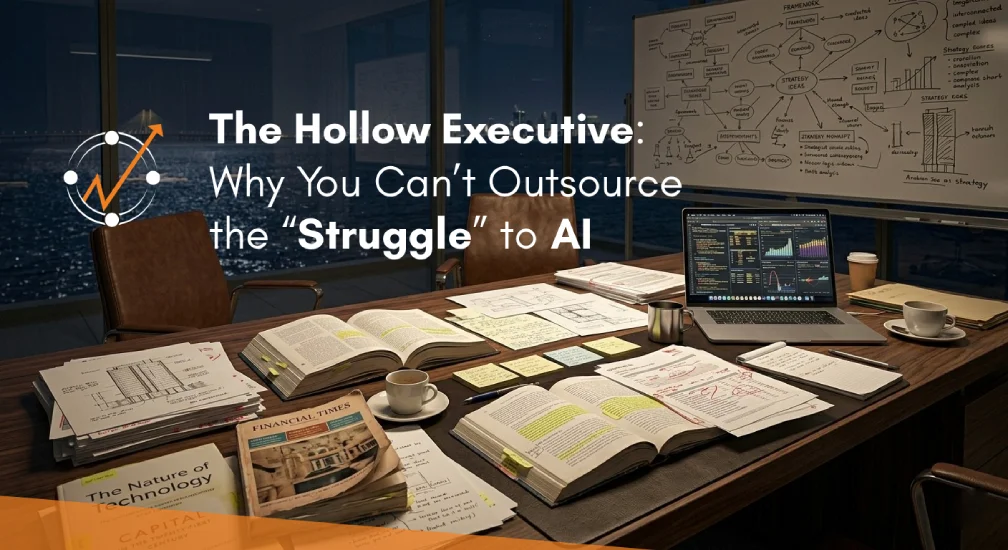
The Hollow Executive: Why You Can’t Outsource the “Struggle” to AI
By Manoj Gupta, Founder
- The Rise of the Hollow Executive
- The Illusion of Instant Expertise
- The Real Risk Isn’t Technical. It’s Psychological.
- The Dangerous Cost of Skipping the Struggle
- The Apprentice’s Path: An Ancient Solution
- AI Should Be a Tutor, Not a Substitute
- How Leaders Can Build Real Depth in an AI Era
- The New Leadership Divide
- The Future Belongs to Leaders with Substance
- Final Reflection
- FAQ
- References
The Rise of the Hollow Executive
We are entering an era where expertise has become increasingly “plug-and-play.”
With modern AI systems and skill-overlay tools, a junior manager can generate:
- a sophisticated legal strategy,
- a market expansion framework,
- a supply chain optimization plan,
- or even a boardroom-level presentation,
…within minutes.
On the surface, the output often looks indistinguishable from the work of someone with twenty years of experience.
It is an extraordinary technological shift.
For businesses, this creates incredible leverage:
- faster execution,
- lower operational friction,
- scalable intelligence,
- and accelerated decision-making.

But beneath this efficiency revolution, a quieter problem is emerging.
A dangerous one.
We are beginning to create professionals who possess answers without understanding.
I call this phenomenon:
The Hollow Executive.
The Illusion of Instant Expertise
For centuries, professional mastery was built through friction.
Doctors developed judgment through years of diagnosis.
Architects learned through structural failures and revisions.
Entrepreneurs built intuition through uncertainty, rejection, and market resistance.
The struggle was never accidental.
It was the training ground that built discernment.
Today, however, AI can compress visible expertise into a beautifully formatted response within seconds.
The danger is subtle:
the output appears complete, so the learning process gets skipped.

This creates a new kind of professional:
- highly articulate,
- technologically fluent,
- presentation-ready,
- but internally fragile.
They know how to operate interfaces.
But they do not fully understand the underlying reality beneath the interface.
The Real Risk Isn’t Technical. It’s Psychological.
The greatest danger of AI is not automation.
It is the illusion of competence.
Research from organizations like MIT Sloan Management Review and Harvard Business Review increasingly explores how AI can improve productivity while simultaneously weakening deep critical thinking when humans become passive consumers of machine-generated conclusions.
This is where leadership becomes vulnerable.
Because leadership is not merely about producing answers.

Leadership is about:
- navigating ambiguity,
- recognizing hidden risks,
- understanding human behavior,
- sensing market shifts,
- and making decisions when no perfect data exists.
That level of judgment cannot be downloaded instantly.
It must be earned.
The Dangerous Cost of Skipping the Struggle
Every industry has what experienced professionals call “gut feel.”
A seasoned negotiator can sense instability before numbers reveal it.
A veteran founder can detect weakness in a business model despite impressive metrics.
An experienced editor can recognize shallow thinking hidden behind polished language.
Why?
Because wisdom is pattern recognition built through lived resistance.
The market teaches through friction.
Reality teaches through consequences.
And when AI removes too much friction too early, people may gain speed while losing depth.
When you outsource struggle, you risk outsourcing judgment.
This becomes especially dangerous during crisis moments.
Because in uncertainty, templates collapse.
Historical patterns fail.
Data becomes incomplete.
Playbooks stop working.
And at that moment, the organization no longer needs people who can generate outputs.
It needs people who can think.
The Apprentice’s Path: An Ancient Solution
Long before AI, ancient guilds understood something modern professionals are forgetting.
A stonemason could not skip directly to mastery.
A carpenter could not bypass apprenticeship.

For years, they worked with raw materials:
- wood grain,
- stone resistance,
- imperfect measurements,
- physical limitations.
The purpose was not merely to complete tasks.
The purpose was transformation.
The apprentice was slowly developing:
- patience,
- instinct,
- judgment,
- and a relationship with reality itself.
The struggle was the curriculum.
Modern leadership requires rediscovering this principle.
Not because technology is bad.
But because human depth still matters.
AI Should Be a Tutor, Not a Substitute
The future does not belong to leaders who reject AI.
Nor does it belong to those who blindly depend on it.
The future belongs to leaders who know how to combine:
- technological amplification,
- with internal clarity.
This requires changing how we use intelligent tools.
Instead of asking AI:
“Write the strategy for me.”
Ask:
“Critique the strategy I created.”
Instead of outsourcing thought, use AI to sharpen thought.
The distinction is critical.
One approach weakens cognition.
The other strengthens it.
How Leaders Can Build Real Depth in an AI Era
1. Lift Your Own Mental Weights
Do the hard thinking first.

Before using AI:
- outline your ideas,
- attempt the analysis,
- wrestle with the uncertainty.
Cognitive struggle builds intellectual endurance.
Just as muscles grow through resistance, judgment develops through mental effort.
2. Study the “Why,” Not Just the “What”
When AI produces an answer:
- examine the assumptions,
- question the logic,
- understand the tradeoffs.
If you cannot explain the reasoning clearly to someone else, you do not yet own the knowledge.
The machine does.
3. Stay Close to the Raw Material
Founders should still speak with customers.
Writers should still wrestle with blank pages.
Designers should still study human behavior directly.
The deeper your contact with reality, the stronger your judgment becomes.
4. Create an “Apprentice Hour”
Dedicate time every week to solving problems without digital assistance.
Read deeply.
Analyze manually.
Think slowly.
In a culture addicted to speed, depth itself becomes a competitive advantage.
The New Leadership Divide
The next decade may create two categories of professionals.
Category One:
People who know how to generate impressive outputs.
Category Two:
People who possess genuine understanding.
The first group may initially move faster.
But the second group will become indispensable when complexity rises.
Because organizations ultimately trust people who demonstrate:
- clarity under pressure,
- independent thinking,
- emotional steadiness,
- and grounded judgment.
Those qualities cannot be automated easily.
The Future Belongs to Leaders with Substance
AI will continue transforming business, education, consulting, medicine, law, and creative work.
That transformation is inevitable.
But amid all this acceleration, one truth remains unchanged:
Technology can amplify intelligence.
It cannot replace wisdom.
And wisdom is still built the old way:
- through experience,
- reflection,
- mistakes,
- observation,
- and struggle.
A powerful tool can improve your reach.
But only depth can improve your leadership.
In a world increasingly filled with hollow expertise, the individuals who cultivate real understanding will become extraordinarily valuable.
Not because they resist technology.
But because they remain deeply human while using it.
Final Reflection
The goal is not to slow progress.
The goal is to prevent ourselves from becoming intellectually dependent on the very tools designed to empower us.
AI can accelerate execution.
But it should never replace the internal process through which judgment is formed.
Because leadership is not built by avoiding the struggle.
Leadership is built through it.
FAQ
Can AI replace professional expertise?
AI can replicate certain outputs associated with expertise, but true professional judgment still depends on human experience, context, emotional intelligence, and critical thinking.
Why is struggle important for leadership development?
Struggle develops pattern recognition, resilience, intuition, and decision-making abilities. These qualities are often formed through direct experience rather than instant answers.
What is the “Hollow Executive”?
The “Hollow Executive” describes professionals who rely heavily on AI-generated outputs without developing deep conceptual understanding or real-world judgment.
How should leaders use AI responsibly?
Leaders should use AI as:
- a thinking partner,
- a research assistant,
- and a critique mechanism,
—not as a complete replacement for independent thought.
Will AI reduce critical thinking skills?
It can, if people become passive consumers of machine-generated conclusions. The key is to actively engage with the reasoning behind AI outputs rather than blindly accepting them.
What is the Apprentice’s Path in modern leadership?
The Apprentice’s Path refers to staying connected to the foundational work of your field, learning through direct experience, and developing wisdom gradually instead of relying solely on shortcuts.
References
- Research and insights on AI, leadership, and organizational learning — MIT Sloan Management Review
- “Good Judgment Is a Competitive Advantage in the Age of AI” — Harvard Business Review
- Research on human expertise, deliberate practice, and skill development — American Psychological Association
Set the Trajectory
There are no reflections on this insight yet. Be the first to initiate the dialogue and share your perspective with the community.



Did this insight shift your perspective?
If this article resonated with you, what is one change or practice you will introduce to your workflow or leadership style moving forward? Share your commitment below.